

Human resources (HR) plays a central role in helping organizations build productive teams, maintain employee satisfaction, and achieve long-term business objectives. While HR is often associated with hiring and payroll, modern HR involves a much broader range of processes that influence nearly every stage of the employee lifecycle.
Well-designed HR processes create consistency, improve employee experiences, reduce administrative problems, and help organizations adapt as they grow. From recruitment and onboarding to performance management and employee offboarding, each process contributes to building a strong workplace.
Here are 11 core HR processes that can support successful organizational growth.
1. Workforce Planning
Workforce planning is the process of determining how many employees an organization needs and what skills will be required to meet future business goals. HR teams work closely with leadership to identify current workforce capabilities, skill gaps, and upcoming staffing requirements.
Effective workforce planning helps organizations avoid both understaffing and unnecessary hiring. It also allows businesses to prepare for expansion, new projects, technology changes, and employee turnover.
2. Recruitment and Talent Acquisition
Recruitment is one of the most important HR processes because organizational success depends heavily on having the right people in the right roles.
The process typically includes creating job descriptions, sourcing candidates, screening applications, conducting interviews, assessing skills, and making hiring decisions. A structured recruitment process can improve hiring quality while reducing time and costs.
Organizations should focus not only on technical qualifications but also on cultural fit, communication skills, adaptability, and long-term potential.
3. Employee Onboarding
Hiring a talented employee is only the beginning. A well-designed onboarding process helps new employees understand their responsibilities, workplace policies, team structure, and organizational expectations.
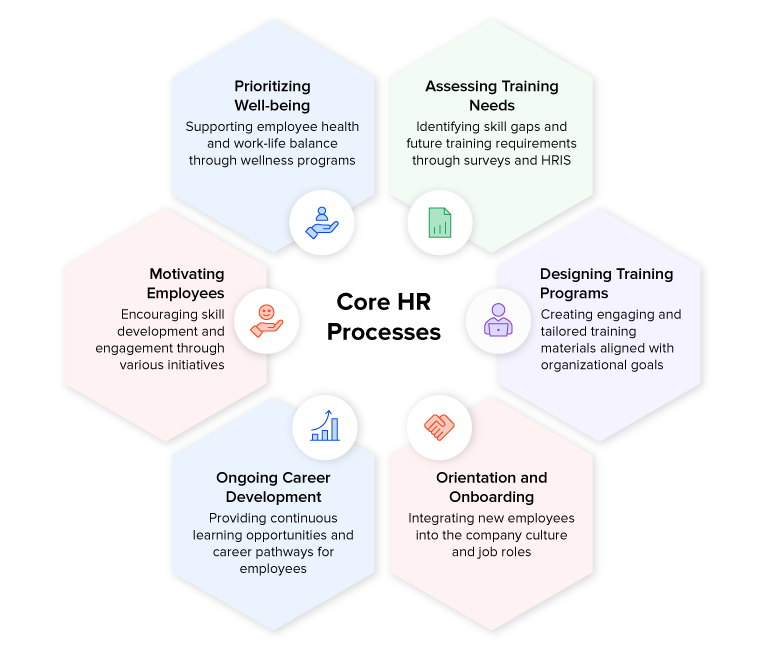
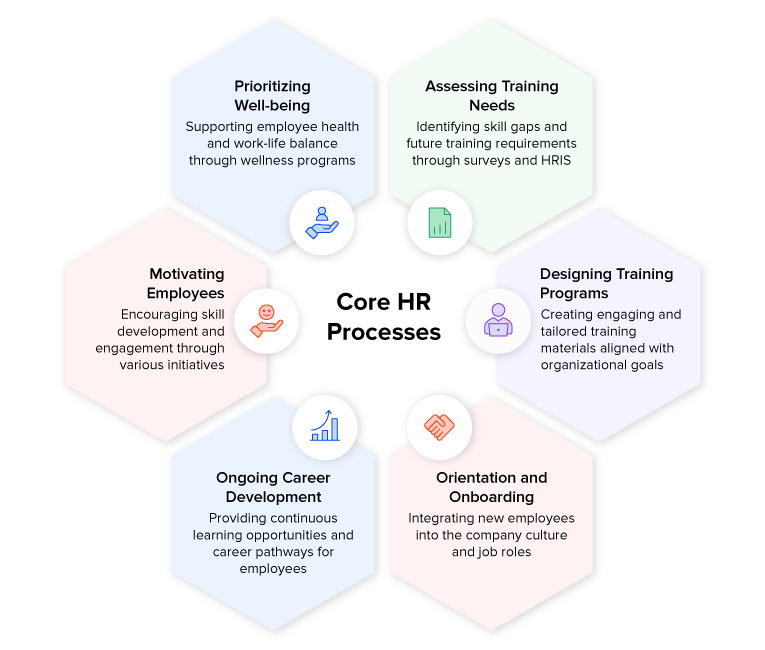
Effective onboarding may include orientation sessions, training, introductions to colleagues, technology setup, and regular check-ins during the first few months.
A positive onboarding experience can help employees become productive faster and feel more connected to the organization.
4. Employee Training and Development
Organizations need employees to continuously develop their knowledge and skills. Training and development programs help workers improve existing capabilities while preparing them for future responsibilities.
HR can identify skill gaps through performance reviews, employee feedback, and business requirements. Training may include workshops, online courses, mentoring, leadership programs, technical education, and professional certifications.
Investing in employee development can also improve engagement and demonstrate that the organization values career growth.
5. Performance Management
Performance management provides a structured approach to setting expectations, monitoring progress, providing feedback, and evaluating employee performance.
Rather than relying only on annual reviews, organizations can use regular performance conversations to help employees understand what they are doing well and where improvement is needed.
Clear goals and measurable performance indicators make evaluations more objective. Managers should also provide constructive feedback and recognize strong contributions.
6. Compensation and Benefits Management
Fair compensation is essential for attracting and retaining employees. HR teams are responsible for managing salaries, bonuses, incentives, benefits, and other forms of employee compensation.
Organizations should regularly review compensation structures to ensure they remain competitive and aligned with employee responsibilities and market conditions.
Benefits such as health coverage, paid leave, retirement plans, flexible work arrangements, and employee assistance programs can also contribute significantly to employee satisfaction.
7. Employee Engagement
Employee engagement focuses on how connected, motivated, and committed employees feel toward their work and organization.
HR teams can improve engagement by conducting employee surveys, encouraging open communication, recognizing achievements, supporting career development, and creating opportunities for employees to share ideas.
Engagement should not be treated as a one-time initiative. It requires continuous attention from HR and organizational leaders.
8. Attendance and Leave Management
Managing attendance and employee leave is another essential HR process. Organizations need clear policies covering working hours, holidays, sick leave, vacation, remote work, and other types of absence.
Automated HR systems can simplify leave requests, attendance tracking, approvals, and record keeping. This reduces administrative work and gives employees greater visibility into their available leave.
Clear and consistently applied policies also help prevent misunderstandings and workplace disputes.
9. Employee Relations
Employee relations involves maintaining healthy relationships between employees, managers, and the organization. HR often acts as a neutral resource when workplace concerns arise.
This process may include handling grievances, workplace conflicts, disciplinary matters, complaints, and communication issues.
Strong employee relations depend on fairness, transparency, confidentiality, and consistent application of organizational policies. Addressing concerns early can prevent small problems from becoming major workplace issues.
10. HR Compliance and Record Management
Organizations must comply with applicable employment laws, regulations, and internal policies. HR is responsible for maintaining accurate employee records and ensuring that processes are handled appropriately.
Important records can include employment agreements, tax documentation, compensation information, attendance records, performance evaluations, and training records.
HR teams should also regularly review policies and procedures as regulations change. Using secure digital systems can improve record accuracy while protecting sensitive employee information.
11. Employee Offboarding
The employee lifecycle does not end with recruitment or employment. Offboarding is the structured process of managing an employee’s departure from the organization.
It may include resignation documentation, exit interviews, knowledge transfer, final payments, benefits information, and the return of company equipment. HR should also ensure that access to organizational systems is appropriately removed.
Exit interviews can provide valuable insights into employee experiences and reveal potential problems involving management, compensation, workload, culture, or career opportunities.
Why Integrated HR Processes Matter
These HR processes are most effective when they work together rather than operating as isolated activities. For example, workforce planning can identify hiring needs, recruitment can bring in suitable candidates, and onboarding can help those employees become productive.
Similarly, training can support performance management, while compensation and engagement strategies can improve retention. Offboarding feedback can then provide information that helps HR improve other processes.
Technology can make this integration easier. Modern HR platforms can bring recruitment, employee records, attendance, performance, payroll, benefits, and reporting into a more connected system.
How Organizations Can Improve HR Processes
Organizations do not need to transform every HR process at once. A practical approach is to identify areas that create the most administrative work or employee frustration and improve those first.
HR teams can document existing workflows, establish clear responsibilities, automate repetitive tasks, measure key outcomes, and collect employee feedback. Regularly reviewing HR metrics can also help organizations identify trends and make better workforce decisions.
Conclusion
Successful organizational growth depends on more than increasing revenue or expanding into new markets. Organizations also need effective systems for attracting, developing, supporting, and retaining their people.
The 11 core HR processes discussed above provide a foundation for managing the employee lifecycle effectively. When these processes are consistent, transparent, and aligned with business objectives, HR can move beyond administrative responsibilities and become a strategic contributor to organizational growth.
By investing in workforce planning, recruitment, onboarding, development, performance management, employee engagement, compliance, and other core HR activities, businesses can build stronger teams and create a workplace that is prepared for sustainable long-term growth.